Printed Lighters: How to Choose Between Logo Printing and Full Wraps
Printed lighters can carry a simple logo, a bold illustration or artwork that covers the entire body. The right choice starts with what you need people to see: your name, a memorable image or a complete design. Choosing the printing format before finishing your artwork helps you avoid squeezing a complicated layout into the wrong space.
For a straightforward logo, start by comparing direct imprint options. For detailed artwork or an all-over background, consider a full wrap. Here is how to choose a format that fits your next merchandise order.
Start with the job your artwork needs to do
Picture someone seeing your lighter on a counter for the first time. Would they recognize the brand without turning it around? If recognition is the goal, give the logo room and keep secondary details small but readable. A logo, a short line of text and a clear background can do more work than a crowded collection of messages.
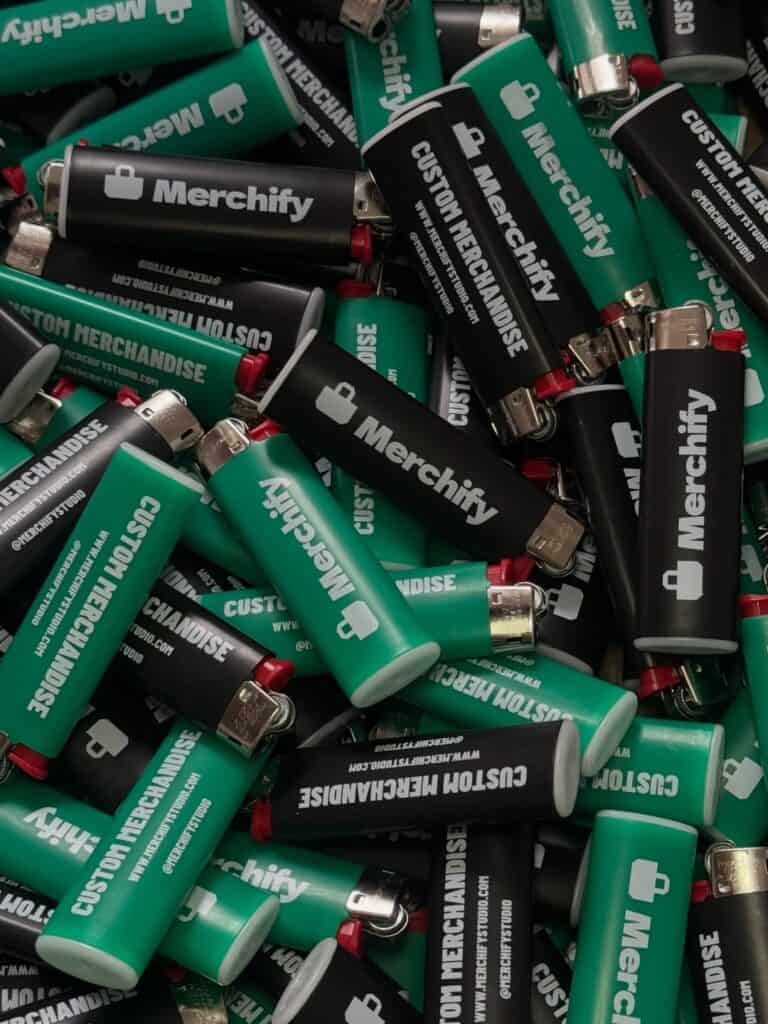
The green and black Merchify lighters shown here demonstrate that approach: white lettering creates contrast against both body colors, while the main brand name remains easy to spot. Use that as inspiration for visual hierarchy, rather than treating every available surface as space that must be filled.
When direct logo printing makes sense
Direct printing is worth considering when your design uses solid colors, clean lettering and a defined imprint area. The custom branded BIC lighter offers one- to four-color pad printing, with options for the front and back.
This format suits a wordmark, a simplified illustration or a compact emblem. The lighter’s body color becomes part of the composition, so evaluate the ink and background together. A design that reads clearly on white may need a different ink treatment on black.
Ask for a proof of each color combination you intend to order. If a fine line disappears when you view the artwork at its actual size, simplify it before approval.
When a full wrap is the better starting point
A wrap gives you a continuous canvas around the lighter body. Custom wrapped BIC lighters use full-color digital artwork, making them an option for gradients, detailed illustrations and backgrounds that extend around the product.
Think of the wrap as a small package design. Choose a primary viewing area, then use the remaining space for supporting artwork. Keep essential lettering away from the template’s seam and trim boundaries. An all-over design still needs a clear focal point.
Compare the order, not just the appearance
Before committing to either format, compare these four details on the current product listing:
- Quantity: Confirm the minimum and whether it applies to each body color or design.
- Artwork: Use the template for the exact product and decoration method.
- Total cost: Compare the same quantity, imprint coverage and delivery destination.
- Timing: Allow for proof approval, production and transit. A wrap and a direct imprint may have very different production schedules.
A smaller imprint can be the right choice even when a wrap offers more coverage. Conversely, simplifying a detailed image just to fit a smaller print area can lose what made the artwork appealing in the first place.
Questions to settle before approving printed lighters
Can I put a QR code on the design?
Discuss it before choosing the printing method. Simply Lighters does not guarantee that pad-printed QR codes will scan and recommends its wrapped BIC option when reliable scanning is essential. Leave enough space around the code and confirm the finished-size requirements with the team.
Does more color automatically make the design better?
No. More color gives you options, but readability depends on contrast, spacing and scale. A strong one-color logo can be more recognizable than a busy multi-color layout.
What should I send with my order?
Prepare the artwork, your preferred lighter model, the quantity and the date you need the order in hand. Review the artwork requirements before uploading your files, then use the proof to check placement and spelling.
Ready to choose? Compare the custom BIC lighter options and select the printing format that makes your artwork easiest to recognize.
